
Séminaire — Susheel Adusumilli
Monitoring coastal hazards at daily to 100 year timescales from storms and sea level rise
· Bell Room (Room 103) in the Rutherford building (3600 University) of McGill University
Perspectives from new Canadian high Arctic and Mountain Ice Cores
· Bell Room (Room 103) in the Rutherford building (3600 University) of McGill University
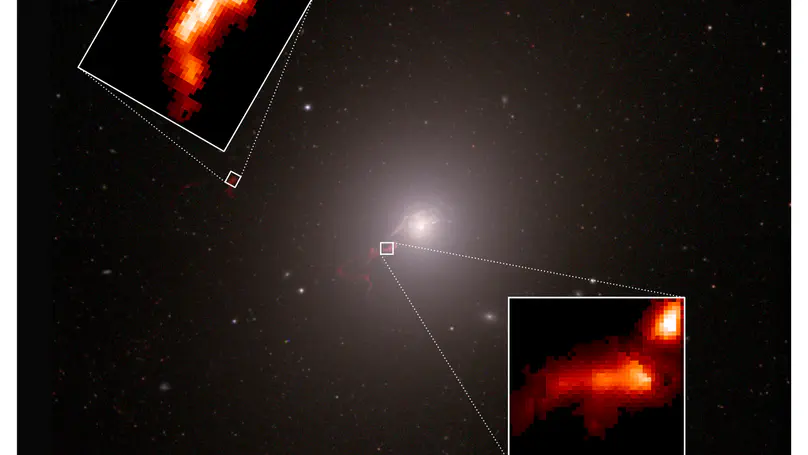
Dissecting the High Energy Environment of Sgr A* in X-rays and IR
· A-2553, Campus MIL de l'Université de Montréal
A brief tour of cosmic conundrums
· Bell Room (Room 103) in the Rutherford building (3600 University) of McGill University
What Changing Pulses Reveal: Probing Pulsar Emission and the Interstellar Medium
· A-2553, Campus MIL de l'Université de Montréal
The Radio Sky in Sync: Coherence, Maser Flares, and Superradiant Bursts
· Bell Room (Room 103) in the Rutherford building (3600 University) of McGill University
From Stars to Statistics: using data-driven variability models to constrain stellar ages
· A-2553, Campus MIL de l'Université de Montréal
24: The hour unit in Ancient Egypt
· Bell Room (Room 103) in the Rutherford building (3600 University) of McGill University
Multimessenger Insights into SMBH–galaxy Growth and Coevolution Across Cosmic Time
· A-2553, Campus MIL de l'Université de Montréal
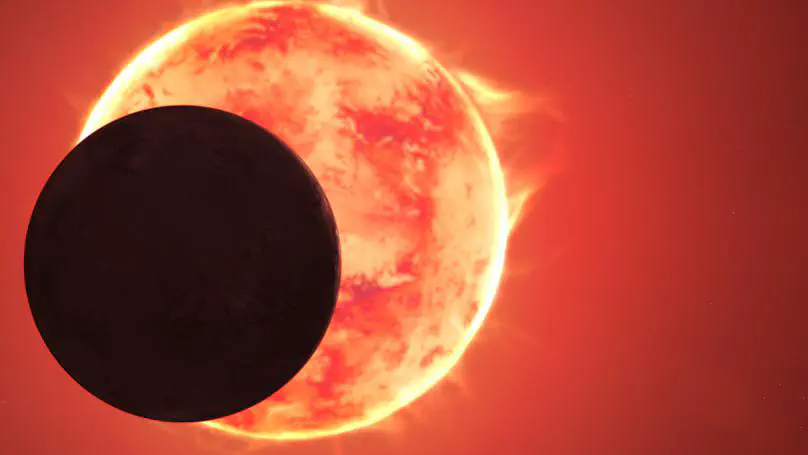
Magnetic interactions around cool stars: grazing comets and hot spot formation
· A-2553, Campus MIL de l'Université de Montréal
Simulate, learn, infer: machine learning for stars and their remnants
· Bell Room (Room 103) in the Rutherford building (3600 University) of McGill University
Regulating the Growth of Galaxies Through their Atmospheres
· Bell Room (Room 103) in the Rutherford building (3600 University) of McGill University
Regulating the Growth of Galaxies Through their Atmospheres
· A-2553, Campus MIL de l'Université de Montréal
Probing Binary Formation in Taurus and Perseus
· Bell Room (Room 103) in the Rutherford building (3600 University) of McGill University
Probing Binary Formation in Taurus and Perseus
· A-2553, Campus MIL de l'Université de Montréal
From Tides to Flybys: Sculpting Exoplanetary Diversity Across the Galaxy
· Bell Room (Room 103) in the Rutherford building (3600 University) of McGill University
From Tides to Flybys: Sculpting Exoplanetary Diversity Across the Galaxy
· A-2553, Campus MIL de l'Université de Montréal
First Light with the CHORD Pathfinder Array
· Bell Room (Room 103) in the Rutherford building (3600 University) of McGill University
TransformerRIM: A Multi-Resolution, Data-Driven Transformer Framework for Radio Interferometric Imaging with Uncertainty Quantification
· A-2553, Campus MIL de l'Université de Montréal
Hidden ice in a warming Canada: Observing and simulating permafrost change
· Bell Room (Room 103) in the Rutherford building (3600 University) of McGill University
How JWST Luminosities Constrain the Local Mass Function and the Smallest Products of Star Formation
· A-2553, Campus MIL de l'Université de Montréal
Titre à confirmer
· Bell Room (Room 103) in the Rutherford building (3600 University) of McGill University
Titre à confirmer
· A-2553, Campus MIL de l'Université de Montréal
Titre à confirmer
· Bell Room (Room 103) in the Rutherford building (3600 University) of McGill University
Titre à confirmer
· Bell Room (Room 103) in the Rutherford building (3600 University) of McGill University
Titre à confirmer
· Bell Room (Room 103) in the Rutherford building (3600 University) of McGill University
Titre à confirmer
· Bell Room (Room 103) in the Rutherford building (3600 University) of McGill University
Titre à confirmer
· Bell Room (Room 103) in the Rutherford building (3600 University) of McGill University
Titre de la présentation à confirmer
· Local A-3521.1
Titre à confirmer
· Bell Room (Room 103) in the Rutherford building (3600 University) of McGill University
Titre à confirmer
· Bell Room (Room 103) in the Rutherford building (3600 University) of McGill University
Titre à confirmer
· Bell Room (Room 103) in the Rutherford building (3600 University) of McGill University
Titre à confirmer
· Bell Room (Room 103) in the Rutherford building (3600 University) of McGill University
Titre à confirmer
· Bell Room (Room 103) in the Rutherford building (3600 University) of McGill University
· Bell Room (Room 103) in the Rutherford building (3600 University) of McGill University
Titre à confirmer
· Bell Room (Room 103) in the Rutherford building (3600 University) of McGill University
Titre à confirmer
· Bell Room (Room 103) in the Rutherford building (3600 University) of McGill University
Titre à confirmer
· Bell Room (Room 103) in the Rutherford building (3600 University) of McGill University
Titre à confirmer
· Bell Room (Room 103) in the Rutherford building (3600 University) of McGill University
Titre à confirmer
· Bell Room (Room 103) in the Rutherford building (3600 University) of McGill University
Titre à confirmer
· Bell Room (Room 103) in the Rutherford building (3600 University) of McGill University
La rencontre annuelle d’AstroQuébec réunit la communauté pour faire le point sur les avancées scientifiques et les initiatives du centre.
Aucune activité n’est prévue cette semaine. Consultez le calendrier pour découvrir les prochains rendez-vous.
Le Centre de recherche en astrophysique du Québec (AstroQuébec) est un regroupement de chercheuses et chercheurs issus des Universités de Montréal, McGill, Laval et Bishop’s, dont la mission commune est de Comprendre l’Univers. Leurs travaux visent à répondre à des questions telles que d’où vient l’univers? De quoi est-il fait? Comment les galaxies et les étoiles y sont-elles apparues? Comment s’est formé le système solaire? Y a-t-il de la vie ailleurs que sur Terre?
AstroQuébec est financé par le Fonds de Recherche du Québec – Nature et Technologie.
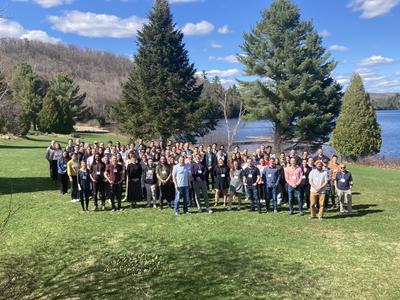
AstroQuébec organise des rencontres scientifiques, des ateliers de formation, des séminaires et des colloques, pour permettre à ses membres d’échanger entre eux et de se maintenir à jours sur les dernières avancées du domaine.
AstroQuébec offre de plus plusieurs bourses de recherche à ses membres pour favoriser la formation de la relève, stimuler les collaborations scientifiques interinstitutionnelles et interdisciplinaires, et renforcer le rayonnement de la recherche en astrophysique au Québec et à l’international.
AstroQuébec facilite aussi la mise en commun des ressources matérielles et humaines de ses membres pour une recherche scientifique de pointe et pour son rayonnement.